Showing posts with label Bombers. Show all posts

Consolidated B-32 Dominator

The Consolidated B-32 Dominator was a long-range, strategic bomber which was in service with the US Army's Air Forces during the last year of World War. It was developed by Consolidated as an 'insurance' against any possibility that the Boeing B-29 project might fail. If events had turned out differently, the big and powerful B-32 might have led the 1944/45 bombing campaign against the Japanese home islands. However, the B-29 succeeded and became and outstanding bomber. Thus, the Dominator importance became marginal, flying only ten combat sorties in the Pacific Theater of Operation before it was retired from service on August 30, 1945. Nevertheless, it was a rugged and stable aircraft, with good handling characteristics, and it could take a lot of beating in the air and it was still able to fly to return to their home base.

The prototype of the Consolidated B-32 Dominator (XB-32 serial #41-141) made its maiden flight on September 7, 1942, fourteen days before the B-29 was able to take to the air. After more than two years of flight tests, it was finally introduced into service with the US Army's Air Forces on January 27, 1945. It was assigned to the 386th Bomb Squadron, which moved from the Philippines to Okinawa, bombing Japan during the last of month of the war. Consolidated built a total of 118 Dominators between 1944 and 1945. The records showed the B-32 was not a total failure her detractors had wrongly claimed. When pressed into combat duty by the Far East Air Forces, the B-32 proved itself to be a sturdy and reliable bombing platform, distinguishing itself for having fought and won the final aerial combat against the Japanese Empire.

Technical Characteristics

The Consolidated B-32 Dominator was a large, four-engine monoplane. It had a semi-monocoque, cylindrical, all-metal fuselage, with flush riveting on the forward section, and standard brazier-head riveting aft of the flight deck. This aircraft was fitted with cantilever, high wing, whose leading and trailing edge tapered towards the tip. The crew compartments were located fore and aft of the dual tandem bomb-bays and they were connected by a catwalk running along a heavily-built beam. The bomb-bays doors were hydraulically powered. The wing was built up on two spars, with metal ribs and flush riveted aluminum skin. The wing central section was mounted high and went through the shoulder of fuselage, and it housed four self-sealing fuel tanks which supplied the bomber's four Wright R-3350-13 Cyclone radial engines with gasoline. Each one of these engines could deliver 2,200 horsepower. The tail assembly consisted of a large vertical fin and rudder, and a tail plane, with a leading edge that swept slightly backward.

Specifications

Type: long-range heavy bomber

Length: 25.32 m (83 feet, 1 inch)

Wing Span: 41.15 m (135 feet)

Wing Area: 132.10 m2 (1,422 square feet)

Height: 10 m (33 feet)

Power Plant: four 2,200-HP, Wright R-3350-13 Cyclone radial, piston engines

Maximum Speed: 575 km/h (357 mph)

Range: 6,115 km (3,800 miles)

Service Ceiling: 10,670 m (35,000 feet)

Crew: 10

Armament: ten 12,7-mm (.50-cal.) M2 Browning machine guns. Provision for 9,100 kg (20,000-lb) of bombs.

Above, the Dominator in flight. It was as large and as powerful than the B-29.

A B-32 flying over California in 1945.

Three Dominators flying over Texas, near Dallas, in March 1945.

Consolidated PB4Y-2 Privateer

The Consolidated PB4Y-2 Privateer was a long-range, maritime patrol bomber used by the US Navy during World War II and the Korean War. It was developed from the Consolidated B-24 Liberator, which was a widely used bomber in WWII. The Liberator was redesigned for the demanding mission of flying long-range maritime patrols. The Privateer differs from the B-24 bomber in having a lengthened fuselage, a prominent single fin, an Erco nose turret, and an updated power plant. In service with the US Navy, the PB4Y-2 flew combat sorties in the Pacific Theater of Operations from late 1944. It was also employed by the French Navy during the French-Indochina War.

The prototype of the Consolidated PB4Y-2 Privateer first flew on September 20, 1943, and it was introduced into service with the US Navy on November 18, 1944. Total Privateer production was 736 aircraft, with the last one being delivered in October 1945. Loudspeaker-equipped PB4Y-2s were used in the Marianas Campaign to encourage Japanese soldiers to surrender. Several Privateers were delivered to the Nationalist China (Taiwan) to carry out reconnaissance missions over the People's Republic of China. However, three of them would be shot down by AA guns for violating its air space. The PB4Y-2B, 2M, 2S, and PB4Y-2K version would also be produced. Its main virtue was its long-range capacity as this aircraft could fly twice as far as the North American PBJ Mitchell, thus being able to cover 4,500 km.

Technical Description

The Consolidated PB4Y-2 Privateer was a large, four-engine monoplane. Its fuselage was of semi-monocoque all-metal construction. The nose of fuselage featured the distinctive Erco nose turret, which carried two .50-caliber M2 Browning machine guns. The aircraft was fitted with cantilever, shoulder wing. Both the leading and trailing edge of wing tapered towards the tip. The tail assembly consisted of a conventional tailplane, which was mounted high on fuselage, and a large vertical fin and rudder. The aircraft was powered by four Pratt & Whitney R-1830 Twin Wasp, radial piston engines, each one being able to deliver 1,350 horsepower.

Specifications

Type: maritime patrol bomber

Length: 22.73 m (74 feet, 7 inches)

Wing Span: 33.53 m (110 feet)

Wing Area: 97.4 m2 (1,048 square feet)

Height: 9.17 m (30 feet, 1 inch)

Power Plant: four 1,350-HP, Pratt & Whitney R-1830 Twin Wasp radial engines.

Maximum Speed: 482 km/h (300 mph)

Range: 4,500 km (2,800 miles)

Service Ceiling: 6,310 m (20,700 feet)

Crew: 11

Armament: twelve 12.7-mm (.50-cal.) M2 Browning machine guns; plus up to 5,800 kg (12,780-lb) of bombs.

Above, the PB4Y-2 in flight during WWII.

A Privateer parked on airbase tarmac. Notice the two M2 Browning machine guns in nose of aircraft.

A PB4Y-2 on an airbase in Shanghai, China, in 1945.

Consolidated B-24 Liberator

The Consolidated B-24 Liberator was a heavy bomber used by the US Army Air Forces during World War II. It was designed for precision attacks from high altitude, using the Norden bombsight. Although the B-17 Flying Fortress was more famous, the B-24 was newer, more efficient and more versatile than the Boeing design. By 1945, around 20,000 aircraft had been built. Thus, more Liberators were built than any other American aircraft in US history. All in all, it was a good bomber, serving on every front of this armed conflict, attacking arm factories and communication centers. However, its most valuable work may have been the war against the German U-boats as it was also used as a maritime patrol and anti-submarine aircraft in the Battle of the Atlantic.

The Consolidated B-24 Liberator prototype, the XB-24, first flew on December 29, 1939. It took off the runway of the Lindbergh Field airbase, San Diego, California. It was flown by chief test pilot William Wheatley. Its power plant consisted of four Prat & Whitney R-1830 piston engines, each one generating 1,200 horsepower. These engines would be replaced by more powerful ones in the first production version. The first production aircraft, which was a batch of six bombers, were rolled out at San Diego in 1940. These would be transferred to the British RAF and they would be followed by another 110 bombers. After almost two years of flight tests, it would finally be introduced into service with the US Army Air Forces in November 1941, as the B-24D version. 2,738 B-24Ds were assigned to the US Army's 8th and 9th Air Forces in Europe and North Africa. However, most of the Liberators, especially the B-24G, B-24H, B-24J, and the B-24L variants, would be employed in the Pacific Theater of Operations.

Technical Description

The Consolidated B-24 Liberator was a large, four-engine monoplane of all-metal construction. The fuselage consisted of semi-monocoque aluminum sheet. It was fitted with cantilever, shoulder wing, with straight leading edge and tapering trailing edge. The tail assembly consisted of a large, straight horizontal stabilizer and twin fins. The fuselage had twin bomb-bays and used roller shutter doors. The B-24D had a glazed 'green house' nose. The aircraft had self-sealing fuel tanks and tricycle-type landing gear. Having an ample fuel storage capacity, the Liberator had a very long range.

Specifications (B-24D)

Type: heavy bomber

Length: 20.22 m (66 feet, 4 inches)

Wing Span: 33.52 m (110 feet)

Wing Area: 97.36 m2 (1,048 square feet)

Height: 5.46 m (17 feet, 11 inches)

Power Plant: four 1,200-HP, Pratt & Whitney R-1830-43 Twin Wasp, radial piston engines.

Maximum Speed: 488 km/h (300 mph)

Range: 2,896 km (1,799 miles)

Service Ceiling: 9,900 m (32,500 feet)

Crew: 10

Armament: ten 12.7-mm (.50-cal) M2 Browning machine guns mounted in four turrets on dorsal, tail, nose, and side positions. 3,629-kg (8,800-lb)

Above, the B-24D variant in flight.

The prototype XB-24 flying over California around 1939.

The B-24J model flying over the Pacific at the end of WWII.

Boeing B-17 Flying Fortress

The Boeing B-17 Flying Fortress was an American heavy bomber used by the US Army Air Corps during World War II. This iconic military aircraft was the first long-range bomber employed by the United States in this armed conflict to attack enemy industrial plants, bridges, and communication centers both in Germany and Japan. The fact that it bristled with machine gun emplacements led to it being called by the press 'Flying Fortress'. The B-17 had first been conceived as a coastal patrol aircraft to guard and protect America's coastlines. However, this large airplane would soon be developed into a crucial offensive weapon to carry out systematic air raids over Germany and Japanese-held islands in the Pacific.

The Boeing B-17 Flying Fortress had been designed to meet an US Army Air Corps requirement for a long-range aircraft, capable of flying at 400 km/h (250 mph). The prototype, Model 299, was taken aloft for the first time on July 28, 1935, by the company pilot Leslie Tower. This big aircraft handled quite well in its first flight, but problems were experienced with the tail wheel; it shimmied (wobbled) slightly. However, it would soon be fixed as well as other technical faults. After three years of flight tests, the Flying Fortress was finally introduced into service with the US Army Air Corps on April 25, 1938, as the B-17B version. By the end of the war, more than 12,000 Flying Fortress bombers had been produced.

The bomber that was to become legendary first saw combat action not with the US Air Corps but with the British Royal Air Force, when, as part of the 90th Squadron of 2 Group, carried out high-altitude, daylight raids against German 'fringe' targets in northern Europe in July 1941. On August 10, 1942, the UK-based US 8th Air Force began its bombing campaign against the Third Reich, using the B-17E variant of the aircraft. However, this version would soon be replaced by the B-17F, which was clearly superior to its predecessor as this new model had incorporated 400 design changes, which included a new power plant, with more powerful Wright Cyclone engines, self-sealing oil tanks, and additional fuel capacity for longer range. By October 1943, the B-17F had partially been supplanted in the first line service by the even better B-17G version, which was fitted with a twin 12.7-mm (.50-cal) Bendix chin turret mounted under nose of aircraft to counter the German fighters head-on attacks.

Technical Description

The Boeing B-17 Flying Fortress was a large four-engine monoplane of all-metal construction. It had monocoque, riveted aluminum fuselage. The aircraft featured cantilever low-wing, with large and strong root. Both the leading and trailing edge of wing tapered towards the tip. Aside from the ailerons, the wing trailing edge was fitted with wide flaps for better handling and control of the aircraft. The aircraft tail assembly was of the conventional type, with a large rudder on the vertical fin. It had retractable landing gear, with the main wheels retracting into engine nacelles. The B-17G was powered by four Wright R-1820-97 Cyclone turbo-supercharged radial piston engines, each one being able to put out 1,200 horsepower.

Specifications (B-17G)

Type: heavy bomber and patrol aircraft.

Length: 22.66 m (74 feet, 4 inches)

Wing Span: 31.62 m (103 feet, 9 inches)

Wing Area: 131.92 m2 (1,420 square feet)

Height: 5.82 m (19 feet, 1 inch)

Power Plant: four 1,200-HP, Wright R-1820-97 Cyclone radial piston engines.

Maximum Speed: 462 km/h (287 mph)

Range: 3,219 km (2,000 miles)

Rate of Climb: 4.6 m/s

Service Ceiling: 10,850 m (35,600 feet)

Crew: 10

Armament: thirteen 12.7-mm (.50-cal) M2 Browning machine guns mounted in chin turret, in nose, on Sperry underbelly turret, and upper Sperry turret; 3,600-kg (8,000-lb) of bombs.

Above, the B-17 taking off from a base runway in England, an iconic bomber of World War II.

A B-17G, the most widely used variant, flying in the skies over California.

A Flying Fortress in flight over Chinese territory to attack Japanese positions.

The B-17F variant flying over Italian territory during the 1943 Allied Italian Campaign.

A B-17E, Nr 12656.

Above, a Flying Fortress during a bombing mission over German territory.

The Sperry ball turret located on belly of aircraft.

Dassault Mirage IV

The Dassault Mirage IV was a two-seat, supersonic bomber, which was in service with the French Air Force from 1964 to 1996. It had the capacity to carry advanced new weapons and avionics thanks to the effective upgrades made by Dassault's engineers. Designed to carry nuclear bombs and missiles, the Mirage IV was the aerial component of the French nuclear deterrence during the Cold War. It was the first European military aircraft capable of flying at sustained Mach-2 speed.

The Dassault Mirage IV was developed from the Mirage III, which was smaller, yet with the same configuration. To transform the interceptor into a bomber, it was necessary to scale it up by a factor of two. The prototype flew for the first time on June 17, 1959, being flown by test pilot Roland Glavany. Three days later, this prototype, the Mirage IV-O1, was authorized to make a pass over the Parish Air Show, with General Charles de Gaulle among the onlookers. It was introduced into service with the French Air Force (Armée de l'Air) on October 1, 1964, as the Mirage IV-A. A total of 62 strategic bombers would be produced.

Front view of the Mirage IV as it maneuvers to take off.

Technical Description

The Dassault Mirage IV was a two-seat, twin-engine monoplane of all-metal construction. The layout and shape was almost identical to that of the Mirage III but it was longer, with a wider wing span, and it was powered by two jet engines instead of one. Therefore, it was fitted with large delta wing and the tail assembly lacked the horizontal plane, having only a large vertical fin. Thus, for take-off, the aircraft used the wing trailing edge flaps as elevators. The aircraft was equipped with air brakes that were mounted on the upper surface of wing root. The Mirage IV had an internal bomb-bay. The fuel tanks were located in the center of fuselage. The jet engines air intakes were situated on the sides of fuselage. Pilot and navigator sat in tandem in a twin-canopy cockpit; they were both provided with Hispano-built Martin-Baker BM.4 ejection seats.

Specifications

Type: long-range strategic bomber

Length: 23.50 m (77 feet, 1 inch)

Wing Span: 11.85 m (38 feet, 11 inches)

Wing Area: 78 m2 (840 square feet)

Height: 5.65 m (18 feet, 6 inches)

Power Plant: two 15,880-lb, SNECMA Atar 9K-50 turbojet engines

Maximum Speed: Mach 2.2 (2,338 km/h or 1,453 mph)

Range: 4,000 km (2,485 miles)

Service Ceiling: 20,000 m (65,617 feet)

Crew: two (pilot and navigator)

Avionics: Thomson-CSF navigation radar

Armament: one ASMP nuclear missile; or six conventional bombs; or four AS.37 Martel anti-radiation missiles.

The Mirage IVA first production bomber as it takes off.

A Mirage IV (on top) and the Mirage III, side by side.

The French bomber on airbase in the late 1960s.

Boeing B-29 Superfortress

The Boeing B-29 Superfortress was a long-range, heavy bomber used by the US Army's Air Forces during World War II. It became the 'big stick' of the final campaign in that armed conflict. This feared aircraft brought war home to Japan's cities and people, ushering in the atomic age. The B-29 was also used used during the Korean War and it would be converted into a transport and tanker aircraft during the post-war years. It was the first and only aircraft to drop nuclear bombs in anger, flying the two missions that attacked Hiroshima and Nagasaki on August 6 and 9, 1945, respectively. It was also the first pressurized aircraft to be introduced into service. Although it began to fly combat sorties late in the war, it had a strong influence on the outcome of the armed struggle as it was armed with the weapons that put an end to it. During the Cold War, it would be developed into the Boeing B-50, also a long-range bomber.

The design of the B-29 Superfortress started in 1940 to meet the US Army's Air Corps requirement for a 'hemisphere defense weapon'. On September 6 that year, Boeing was awarded the $ 3,615,095 contract for building two XB-29 prototypes; three months later a third prototype would be added. The first of them made its maiden flight on September 21, 1942. Almost two years of flight tests had gone by when the aircraft was finally accepted, entering service with the US Army's Air Forces on May 8, 1944. This new heavy bomber flew its first combat sortie on June 5, 1944, taking off from airbases in India to attack Japanese military depots and command centers in Bangkok, Thailand. After the Battle of Iwo Jima, the B-29 began taking off from the new Allied airbase on this island to carry out bombing raids over Japanese cities. The most famous missions conducted by this heavy bomber were the ones in which it dropped two atomic bombs on Hiroshima and Nagasaki. A total of 3,970 bombers were made in different versions.

Above, the B-29D version in flight over China in early 1945.

Technical Description

The Boeing B-29 Superfortress was a large, four-engine monoplane of all-metal construction. It was fitted with wide-span mid-wing. The basic airframe was made of aluminum alloy, with a semi-monocoque fuselage and stringers arrangement which had been used for the construction of the B-17 Flying Fortress. The fuselage had a circular cross-section, whose purpose was twofold: to obtain maximum strength for pressurization and for a streamline shape and flight efficiency. It was built in four separate sections, which were assembled on the production line. Two aluminum web spars were employed to build the wing, which was made stable through the use of a 4.5-degree dihedral angle and a 7-degree leading edge sweepback. The ailerons and flaps occupied the full length of the trailing edge.

The tail assembly, or empennage, consisted of cantilever vertical and horizontal stabilizers (fin and tailplane). These were built with spars and ribs covered with stressed sheet metal skins. Fabric was used on the elevators and rudder. All the primary flight controls, such as ailerons, rudder, and elevators, were cable-operated. Electricity was supplied by a 28-volt direct current, which was produced by six generators powered by the engines. The tricycle landing gear of the B-29 was entirely conventional, except for size, and it was electrically operated. The first version of the aircraft, the B-29A, was powered by four Wright Cyclone R-3350-5, 18-cylinder, piston engines, each of them producing 2,200 horsepower. For its bombing missions and navigation, the aircraft was equipped with an AN/APQ-7 radar.

Specifications

Type: long-range heavy bomber

Length: 30.18 m (99 feet, 2 inches)

Wing Span: 43.05 m (141 feet, 3 inches)

Wing Area: 161.27 m2 (1,736 square feet)

Height: 9 m (29 feet, 7 inches)

Power Plant: four 2,200-HP, Wright R-3350-5, Duplex-Cyclone, 18-cylinder, turbo-charged piston engines.

Maximum Speed:576 km/h (358 mph)

Range: 5230 km (3,250 miles)

Service Ceiling: 9,170 m (30,095 feet)

Crew: 11

Armament: eight 12.7-mm (.50-cal) machine guns mounted in four remotely control turrets; one 20-mm gun in tail (sometimes a pair of .50-cal machine guns); 9,072 kg (20,000-lb) of bombs in bomb-bay.

The B-29A flying over California in May, 1944.

B-29s from 500th Bomb Group in the skies over Japan dropping incendiary bombs.

The Superfortress bombers in flight around July 1945, with olive-green camouflage.

Front view of the B-29. The 4.5-degree dihedral angle of wing is clearly noted.

Rockwell B-1 Lancer

The Rockwell B-1 Lancer is an American, strategic, jet bomber introduced into service with the US Air Force at the end of the Cold War. It is a swing-wing supersonic bomber, which is capable of hauling a large bomb-load; 52,160 kg (114,993-lb) of ordnance. It was developed as a replacement for the B-52 Stratofortress, a heavy subsonic bomber that had been used in the Vietnam War. The B-1, nicknamed the ''Bone'', was used in combat in Operation Desert Storm in 1991 and in the invasion of Iraq in 2003.

The first prototype of the B-1 Lancer (B-1A - serial number 74-0158) rolled out of the US Air Force Plant 42, Palmdale, California, on October 26, 1974, and it made its first flight on December 23, 1974. It was flown by a Rockwell test pilot, Charles C. Bock. It was the result of a 1970 bid for a supersonic strategic bomber. Boeing, General Dynamics, and Rockwell had taken part in the competition, with Rockwell being awarded the contract for research, development, and building the whole aircraft and General Electric for developing the power plant. On October 1, 1986, it finally entered service with the US Air Force as the B-1B version, after twelve years of trials and technical improvement. Rockwell produced 4 B-1As and 100 B-1B bombers.

In 1977, US President Jimmy Carter had cancelled the B-1A program due to the huge cost that it would imply building 240 aircraft. He had concluded that the job of striking at the Soviet Union in case of war could be done by the old Boeing B-52 equipped with long-range, stand-off weapons. However, in 1981, President Ronald Reagan had revived the program and the B-1B version would be produced in large number.

Above: the B-1B Lancer in flight in 1988.

Technical Description

The Rockwell B-1 Lancer is a four-engine, supersonic monoplane of all-metal fuselage. Titanium make up 21 percent of aircraft airframe. It features variable geometry sweep wing, which is mounted low on fuselage. When fully forward, wing leading edge has a 15° sweep, and 67° when swept backward. The carry-through structure, which connects the outer wings with their pivots, is made of titanium alloy, because it has to be strong enough to withstand the rigors of the wing sweep operation for high speed and low altitude. The aircraft has eight internal fuel tanks for the four General Electric F101-GE-102 turbofan engines. Each of the engine delivers 30,780 pounds of thrust with afterburner.

The cockpit of the B-1 is part of the escape capsule as the aircraft lacks ejection seats. This escape capsule allow the 4-man crew to leave the aircraft in an emergency when flying at high speed. Normal ejection at high speed would be fatal using ejection seats. The cockpit features fighter-type control sticks, vertical scale flight instruments, and TV screens for a forward-looking infra-red image. Two of the three long bomb-bays are located in fuselage ahead of wing, while the third one is above the end of engine nacelle. The aft portion of fuselage is equipped with a radome, in which a pulse-Doppler radar is located. The forward portion of fuselage is fitted with a pair of canards.

Specifications (B-1B)

Type: long-range, supersonic strategic bomber.

Length: 45.7 m (150 feet, 2 inches)

Wing Span (fully-forward): 42 m (137 feet). Swept: 24 m (79 feet)

Wing Area: 181 m2 (1,950 square feet)

Height: 10.24 m (33 feet, 7 inches)

Power Plant: four 30,780-lb, General Electric F101-GE-102 turbofan engines.

Maximum Speed: Mach 1.25 (1,335 km/h = 830 mph)

Range: 9,400 km (5,900 miles)

Service Ceiling: 18,000 m (60,000 feet)

Rate of Climb: 28.8 m/s

Crew: 4

Armament: 52,160 kg (114,993-lb) bomb-load, in three internal bays and on hardpoints for Mk-84 general purpose bombs, GBU-54 Laser JDAM bomb, AGM-158 JASSM air-to-surface missiles, and AGM-154 Stand-Off Weapons.

Front view of the ''Bone''. Notice the four engine air intakes.

Rear vie of the Lancer as it takes off.

The B-1 in flight with wings swept back.

The B-1A version as it takes off with wing fully forward.

Wing trailing edge, with flap fully extended.

The B-1A variant prototype about to touch down.

Northrop B-2 Spirit

The Northrop B-2 Spirit is a long-range, strategic bomber in service with the US Air Force since 1997. Together with the B-1, this stealth aircraft forms the backbone of the United States deterrence strategic force. It is based on the experimental, boomerang-shaped XB-35 piston-engine bomber of the late 1940s. The B-2 has the dark mission of flying over enemy territory in an atomic war. Long kept under a cloak of secrecy, it is out in the open today, known to the public. As of June 2025, it might be used to carry out a bombing mission to strike targets in Iran to destroy its nuclear enrichment plants.

The first B-2 Spirit prototype, the AV-1 (82-1066), performed its maiden flight on July 17, 1989. The second prototype, the AV-2 (82-1067), flew from Palmdale to Edwards airbase, California, on October 19, 1990, while the third one, the AV-3 (82-1068), did likewise on June 18, 1991. By the time the first aircraft was delivered to the US Air Force, the B-2 had achieved several important milestones; it had completed fatigue tests to 20,000 hours; it had undertaken all navigation and autopilot trials; and it had passed static load tests. Having passed all trials, mass production was authorized, with the main contractors being Northrop Grumman's B-2 Division, Boeing Military Aircraft Company, Hughes Radar System Group, and General Electric Aircraft Engine Group.

The B-2 production ended in 1997, when 21 bombers had been produced. The US Air Force accepted delivery of the aircraft in three configuration blocks, which were designated Block-10, Block-20, and Block-30. They are powered by four General Electric F118-GE-100 turbofan engines, each one delivering 19,000 pounds of thrust. It first saw combat action in 1999, flying sorties to strike targets in Yugoslav, using Joint Direct Attack Munition. It also took part in the war in Afghanistan in Operation Enduring Freedom from 2002 onward.

Above, the B-2A Spirit in flight in 1997.

Technical Description

The Northrop B-2 Spirit is a two-seat, four-engine, subsonic monoplane, with a boomerang-shaped configuration. It has no conventional fuselage, with the entire structure being contained within a smoothly blended delta wing. The aircraft wing trailing edges form a ¨W¨ shape, while the leading edge has 33-degree sweep, as they are both designed to trap and deflect radar energy away. It has no tail assembly, lacking a tail plane and a vertical fin as the two triangular-shaped elevators are part of rear portion of fuselage. All moving surfaces (ailerons, flaps, and elevons) of trailing edge are computer-controlled. The bomb-bay is smoothly and snugly-contained within the fuselage.

The B-2 engines exhaust through V-shaped outlets, which are set up back and above the trailing edges. The purpose of this design is to hide the engine exhaust heat from enemy ground radar. The four General Electric F118 engines are buried deep within the aircraft fuselage, keeping the turbofan blades away from enemy radar transmissions. The fuselage is covered in graphite/epoxy materials, which absorbs radar waves and avoid reflection, thus contributing to the bomber's stealthiness. The cockpit windshields are 4-inch-thick laminated acrylic. The aircraft is fitted with a Hughes AN/APQ-181 phase-array radar, which is buried in the front fuselage.

Specifications (B-2A Spirit)

Type: long-range, strategic, stealth bomber

Length: 21 m (69 feet)

Wing Span: 52.43 m (172 feet)

Wing Area: 196 m2 (2,100 square feet)

Height: 5.18 m (17 feet)

Power Plant: four 19,000-lb-thrust, General Electric F118-GE-100 turbofan engines.

Maximum Speed: 1,044 km/h (648.7 mph)

Range: 12,225 km (7,596 miles)

Service Ceiling: 16,920 m (53,440 feet)

Crew: 2

Armament: eight B61 or B83 nuclear bombs; or sixteen stand-off cruise missiles; or 22,600 kg (50,000-lb) of conventional bombs, such as JDAMs, GBU-28, and GBU-57 guided bombs.

The AV-3 prototype in flight over California.

Above, the eighth B-2A (89-0129), assigned to the 509th BW, flies over the Sierra Nevada Mountains, near Edwards Air Force base, California.

The B-2 Spirit is about to touch down. Notice the landing gear, which is an adaptation of the Boeing 747's.

Historical footage of the Northrop B-2 Spirit bomber (video)


Boeing B-47 Stratojet

The Boeing B-47 Stratojet was a long-range, strategic bomber in the arsenal of the US Air Force during the Cold War. For eighteen years, it was the backbone of the US Strategic Air Command (SAC). There were nearly two thousand Stratojet bombers always poised and ready to take to the air, carrying its lethal cargo of atomic bombs. However, many of them were also used in the reconnaissance role. Despite its size, the aircraft had an exceptional handling for formation flying as it was also able to accomplish loops and rolls.

The prototype of the B-47 first flew on December 17, 1947, defeating several rivals to become the US Air Force's choice as its main strategic bomber of the 1950s. After almost four years of flight tests, it was finally introduced into service in October 1951, when the first batch of ten B-47B bombers were delivered to the Strategic Air Command. It was the first swept-wing, jet bomber ever produced and it had breathtaking performance. It participated in reflex deployments between the United States and Great Britain.

Above, the B-47B in flight, the first production variant.

Technical Description

The Boeing B-47 Stratojet was a six-engine, jet monoplane. It had cantilever, 35-degree swept-back wing, which was mounted high on fuselage. It had an extremely high aspect ratio, with a fine aerodynamic efficiency. The wing was built in such a way that during maneuvers they could flex up to 3 m (10-ft), allowing the bomber to accomplish loops and barrel rolls during certain attack procedures. The aircraft tailplane was also 35-degree swept-back, with a large vertical fin on top.

The all-metal fuselage of the B-47 had a large bomb-bay, which was capable of carrying 9,071 kg (20,000-lb) of bombs. The bomber had a narrow cockpit. Thus, the two pilots sat in tandem, under a bubble Plexiglas canopy. For the pilot sitting in front, visibility was excellent. Because of the thin wings, fuel was carried in two main tanks located above and to the rear of weapons bay. A tandem or bicycle arrangement was used for the main landing gear.

Specifications (B-47E)

Type: long-range, strategic bomber

Length: 33.48 m (109 feet, 10 inches)

Wing Span: 35.36 m (116 feet)

Wing Area: 132.66 m2 (1,428 square feet)

Height: 8.51 m (27 feet, 11 inches)

Power Plant: six General Electric J47-GE-25/25A turbojet engines, each capable of developing 7,200 lb of thrust, with water injection.

Maximum Speed: 975 km/h (606 mph)

Cruising Speed: 806 km/h (501 mph)

Range: 6,437 km (4,000 miles)

Service Ceiling: 12,345 m (40,500 feet)

Crew: 3

Armament: two backward-firing 20-mm cannons mounted in tail turret; 9,071-kg (20,000-lb) of bombs.

Above, a color picture of the B-47E, the most massively produced version of the bomber. Notice the drop tanks under wings.

The prototype XB-47 in 1948.

Front view of prototype in flight.

Above, the B-47E version in flight in 1959.

Stratojets flying in formation in the late 1950s.

Below, the Boeing B-47 Stratojet take-off (footage)


Boeing B-50 Superfortress

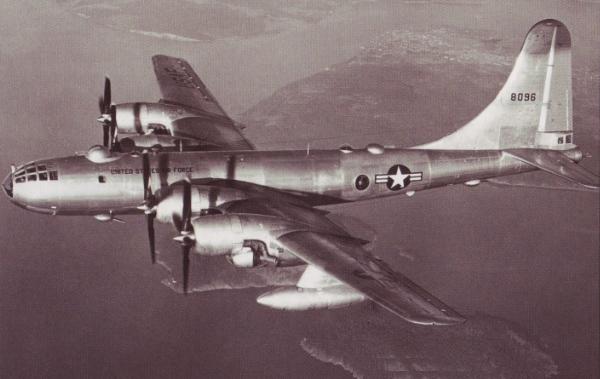
The Boeing B-50 Superfortress was a long-range, heavy-bomber used by the US Air Force during the first years of the Cold War. It was developed from the B-29, which had been employed during World War II. Although they looked similar, the B-50 could be distinguished from its predecessor by its taller tail fin, underwing fuel tanks as the bomb bay was modified to accommodate nuclear bombs. Phased out in 1965, it was the last of the USAF's piston-engine bombers. Aside from its strategic deterrence role, it would also be used as a tanker.

The Boeing B-50 first flew on June 25, 1947, entering service the following year, in June 1948. On March 2, 1949, the B-50 ¨Lucky Lady II¨ completed the first non-stop, round-the-world flight, covering a distance of 37,742 km (23,452 miles). In the 1950s, it carried out reconnaissance missions around the periphery of the Soviet territory, while others were used to train Strategic Air Command pilots. Being replaced by jet aircraft in the bomber role, most of them would be converted into tankers. A total of 370 production B-50s and one prototype were built for the US Air Force.

The Boeing B-50A, flying off the coast of California in 1948.

Technical Characteristics

The Boeing B-50 was a two-engine, mid-wing monoplane built with an all-metal fuselage. It had dihedral, cantilever wing, with the leading edge tapering towards the tip, while the trailing edge was straight. The aileron was fitted on the wing outer section. The wing was made with a new type of aluminum, known as 75-ST instead of the 24-ST used on the B-29. This new type of aluminum made the wing stronger and 600-lb (272-kg) lighter.

An internal pressure bulkhead between the rear cabin and the bomb-bay was located at the beginning of rear portion of fuselage. Crew members moved between the front and rear pressure cabin through a pressurized tunnel above the bomb-bay. The B-50 was equipped with more powerful engines; four Pratt & Whitney R-4360-35 Wasp Major, turbo-charged, 28-cylinder, radial piston engines, each one of them delivering 3,500 horsepower. The bomber had four remotely-controlled gun turrets for the 12.7-mm (.50-cal.) machine guns and the backward-firing 20-mm cannon in the tail.

Specifications

Type: long-range, strategic bomber

Length: 30.18 m (99 feet)

Wing Span: 43 m (141 feet, 3 inches)

Wing Area: 161.55 m2 (1,739 square feet)

Height: 9.96 m (32 feet, 8 inches)

Power Plant: four 3,500-HP, Pratt & Whitney R-4360-35, 28-cylinder radial engines.

Maximum Speed: 620 km/h (385 mph)

Range: 7,483 km (4,650 miles)

Service Ceiling: 11,278 m (37,000 feet)

Crew: 8

Armament: twelve 12.7-mm (.50-cal) Browning machine guns; one 20-mm canon; 9,072-kg (20,000-lb) bomb-load.

The B-50D version in flight in 1954.

Dornier Do 217

The Dornier Do 217 was a German bomber and night fighter used by the Luftwaffe in every theater of operations of World War II. Developed from the Do 17, it had a longer range and a larger bomb load capacity than its predecessor. Although its main role was as a bomber, providing support to front line troops, it was also employed as a night fighter, night interceptor, and anti-ship attack aircraft. In this latter role, it flew sorties in the Mediterranean theater, attacking Allied convoys and warships. The first production variant of this bomber was the Do 217E-1 and the last one was the 217P-0, which was a high-altitude reconnaissance bomber. The 217R would be renamed Do 317.

Prototypes and first production version

First flown in August 1938, the first prototype of the Dornier Do 217, V1, was powered by two Daimler-Benz 601A piston engines, with each one delivering 1,075 horsepower (802 kW). Despite its similar appearance to the Do 17, it was a totally new design. The following prototypes would be equipped with Junkers Jumo 211A and BMW 139 engines. However, the V9 prototype would be fitted with more powerful engines: the BMW 801, which generated 1,538 horsepower (1,147 kW).

Before mass production began, the first aircraft into service was a batch of eight Do 217A-0 aircraft, which were modified for the reconnaissance role, serving with the Aufklärungsgruppe Ob.d.L. Delivered to the special unit in April 1940, the aircraft undertook clandestine reconnaissance missions over the Soviet Union, way ahead in preparation for the invasion of the country that would take place in 1941. Meanwhile, the V9 prototype would enter service in late 1940, as the Dornier Do 217E-1, which was the first ¨deep body¨ version that was able to carry the massive bomb load of 4,000 kg (8,818-lb), of which 2,517 kg was inside the bomb bay. Like its prototype, the V9, the 217E-1 was powered by two BMW 801 radial engines.

Night fighter variant

In 1941, Dornier proposed to develop a night intruder version of the aircraft. Having been authorized, they came out with the Do 217J-1 night fighter, whose main and obvious change was the nose. Instead of a multi-pane Plexiglas nose for the bomb aimer, this version had a solid nose in which four 20-mm MG FF cannons were mounted, and four 7.92-mm MG-17 machine guns. The Do 217J-2 was fitted with the FuG 202 or the Lichtenstein BC radar for night operations. The other variant specialized as night fighter was the Do 217N-1, which first flew on July 31, 1942; it was powered by two Daimler-Benz 603 engines. Production for this aircraft began in January 1943.

Standard bomber version

The Dornier Do 217K-1 was the most widely employed bomber variant, which was a specialized night bomber. Mass production of this aircraft began in October 1942. It was very similar to the 217E-series, with the only real changes being the new BMW 801D radial engines, each one delivering 1,700 HP. Thus it was faster and had a longer range than the 217E, and a redesign of the forward fuselage, with a new nose similar to that of the Heinkel He 177, in which its front glazed part continued up to the top of forward fuselage. For night missions, it was also fitted with the FuG 202 radar, which would be replaced by the FuG 220. The Do 217K-2 was a specialist version for the carriage of the Fritz X glide bomb.

Above, the Do 217 flying over the Soviet Union.

Technical Characteristics

The Dornier Do 217 was a two-engine, medium-sized monoplane, built with an all-metal fuselage. It was fitted with cantilever shoulder-wing, which was made with two spars in three sections. The wing trailing edge was fitted with slotted ailerons, which were set up on the outer wing section. The tail consisted of a convention straight horizontal stabilizer with twin fins. The landing gear was retractable, with the main wheels folding up into the engine nacelles.

Specifications (Do 217N-2)

Type: four-seat, night interceptor, intruder fighter, and bomber.

Length: 18.9 m (62 feet)

Wing Span: 19 m (62 feet, 4 inches)

Wing Area: 57 m2 (614 square feet)

Height: 5 m (16 feet, 5 inches)

Power Plant: two Daimler-Benz DB 603A, 12-cylinder, liquid-cooled engines, each rated at 1,750 HP.

Maximum Speed: 425 km/h (264 mph)

Range: 1,755 km (1,090 miles)

Service Ceiling: 8,400 m (27,559 feet)

Crew: 4

Armament: four 20-mm MG-151 cannons in lower nose; four 7.92-mm MG-17 machine guns in fuselage nose. Bomb load (Do 217K version): 4,000 kg.

The Dornier Do 217K version on a German airbase in 1943.

The Do 217P was the last version of the aircraft.