Showing posts with label Trainers. Show all posts

North American T-2 Buckeye

The North American T-2 Buckeye was an intermediate, general-purpose, jet trainer, which was used by the US Navy from 1959 to 2008. Originally called the T2J, this sturdy and reliable aircraft had begun its long career as a single-engine design but it would evolve into a twin-jet trainer in 1966. It is estimated that around 18,000 naval aviators received training on the Buckeye. It was fully carrier-capable as thousands of naval pilots made their first carrier landing flying it.

The T-2 prototype, the YT2J-1, made its maiden flight on January 31, 1958. It was flown by test pilot Richard Wenzell. Only minor technical difficulties with the landing gear were experienced. However, they were set right immediately. It was introduced into service the following year, on November 25, 1959. In 1962, the US Navy awarded North American a 3.3 million-dollar contract to modify its first version, the T-2A, to a twin-engine aircraft, which entered service in 1966. This was possible due to the emergence of modern, efficient, light-weight turbojets in 1960. More than 500 T-2 aircraft would be produced in different versions; T-2A, T-2B, T-2C, and T-2D.

Technical Description

The North American T-2 Buckeye was a two-seat, twin-engine, carrier-borne monoplane. It was fitted with cantilever mid-wing, which was of all-metal construction, with a two-spar structure. The wing had all-metal ailerons with hydraulic boost, and large trailing-edge flaps. The aircraft fuselage was also of all-metal construction, with semi-monocoque structure, which was divided into three main sections: forward fuselage, containing equipment bay and cockpit; center fuselage, housing power plant, fuel, and wing carry-through structure; rear fuselage, carrying the arrester hook and a hydraulically-actuated air-brake on each side.

The T-2 tail assembly was also all-metal, with a cantilever tail plane, whose elevators were boosted hydraulically. On the other hand, the tail fin rudder was manually controlled. It had retractable, tricycle landing gear, with oleopneumatic shock absorbers and hydraulic retraction; main units retract inwardly into wings, while nose wheel folded up forwardly into fuselage. The arrester hook was also retractable. Jet engine air intakes were located on belly of fuselage.

Specifications

Type: general-purpose jet trainer

Length: 11.67 m (38 feet, 4 inches)

Wing Span: 11.62 m (38 feet, 2 inches), with tip tanks.

Wing Area: 23.69 m2 (255 square feet)

Height: 4.51 m (14 feet, 9 inches)

Power Plant: two General Electric J85-GE-4 turbojet engines, each one delivering 2,948 pounds of thrust.

Maximum Speed: 840 km/h (521 mph)

Range: 1,685 km (1,045 miles)

Service Ceiling: 12,320 m (40,400 feet)

T-2C in flight

Above, the T2J-1 146001 on an early carrier flight deck landing trial.

The T-2B version in flight

Above, the instrument panel of the Buckeye

Cessna T-37

The Cessna T-37 was the primary training aircraft in service with the US Air Force for more than fifty years. Nicknamed the 'Tweet', it was a very stable and reliable jet trainer, with two side by side seats. Every US Air Force's pilot flew it during basic training in the Cold War period. The prototype, the XT-37, had performed its first flight on October 12, 1954, entering service in 1957. After several decades, it would be phased out in 2009.

The Cessna T-37 Tweet had been designed in 1952 to meet a USAF requirement for a jet-engine-powered primary trainer. It was a very practical trainer, with a low and wide-tracked landing gear to ease landing and ground handling. The side-by-side seating arrangement made student instruction easier, allowing for close coordination between the instructor and the fledgling during all phases of training. The flight characteristics of this trainer allowed students to solo after as little as six and a half hours of dual instruction. The aircraft's stability enabled it to be safely used for formation flying.

The US Air Force ordered a total of 444 T-37A aircraft, which was the first version that was built until 1959. Then Cessna switched production to the T-37B variant, with 466 aircraft being produced; this version had upgraded Continental J69 turbojet engines and improved navigation and communications equipment. The T-37C was the last Tweet, but it was never used by the USAF as it was produced only for export, with 269 trainers being sold to ten countries. This trainer would be developed into the A-37 Dragonfly, a ground-attack aircraft used in the Vietnam War.

Below, the T-37B version of Tweet in flight in the 1960s.

Technical Description

The Cessna T-37 was a two-seat, twin-engine monoplane, with a straight, cantilever, low-wing configuration. The fuselage was all-metal semi-monocoque. The cockpit had two side-by-side ejection seats, with a canopy that was blown off (jettisoned) during emergency, and oxygen equipment; however it was not pressurized, which limited the service ceiling to 25,000 feet (7,620 m).

The Tweet had wide-track, short landing gear. This feature made landing easier for the new pilots and also eliminated the need for ground stands and ladders as all areas of the engine compartment was readily accessible from ground level. The T-37B version was powered by two Continental J69-T-25 turbojet engines which were buried in wing roots. They were the license-built version of the French Turbomeca Marboré used in the Fouga Magister.

Specifications (T-37B)

Type: trainer

Length: 8.92 m (29 feet, 3 inches)

Wing Span: 10.30 m (33 feet, 9 inches)

Wing Area: 17 m2 (184 square feet)

Height: 2.68 m (8 feet, 10 inches)

Power Plant: two Continental J69-T-25 turbojet engines, each delivering 1,026-lb thrust

Maximum Speed: 685 km/h (425 mph)

Range: 972 km (600 miles)

Rate of Climb: 1,067 m/min.

Service Ceiling: 7,620 m (25,000 feet)

Crew: two

The prototype of the Tweet, the XT-37, on the tarmac of an airbase, around 1955.

Below, three T-37A aircraft. The US Army tested the first variant of the trainer in the summer of 1957 under the High Performance Army Observation Aircraft program (HPAOA). However, the Tweet would not be accepted by the Army as it would choose the Grumman OV-1 Mohawk instead.

The Tweet in flight. It was a T-37A, the second one built, No 42730. It was on its acceptance flight over the Kansas prairie.

Below, the Cessna trainer on final approach for landing. Its wide-track landing gear made landings easy for fledgling pilots.


Vultee BT-13 Valiant

The Vultee BT-13 Valiant was a two-seat, trainer aircraft used by the US Army Air Forces during World War II. Developed from the BC-3, the prototype, the Model 74, first flew in March 1939. It was the most prolific basic trainer of this period, entering service in June 1940.

The main production variant was the BT-13A, with 6,407 aircraft built. It was powered by one Pratt & Whitney R-985 AN-1, 9-cylinder, air-cooled radial engine, which produced 450 horsepower. This version was followed by the BT-15, which was equipped with one 450-HP, Wright R-975-11 Whirlwind-9 radial engine. Although it was a reliable and easy-to-fly aircraft, both versions were quickly retired after the war.

Technical Characteristics

The Vultee BT-13 Valiant was a two-seat, single-engine monoplane. It had an all-metal structure, with cantilever low wing, with all control surfaces being fabric-covered. The landing gear featured oleo-pneumatic shock struts, a steerable tailwheel, and hydraulic brakes. The cockpit provided accommodation for a crew of two, who were seated in tandem beneath a continuous transparent canopy.

Specifications

Type: basic trainer

Length: 8.79 m (28 ft, 10 inch)

Wing Span: 12.80 m (42 ft)

Wing Area: 22.20 m2 (239 sq. ft)

Height: 3.51 m (11 ft, 6-inch)

Powerplant: one Pratt & Whiney R-985 AN-1, 9-cylinder radial engine.

Maximum Speed: 290 km/h (180 mph)

Service Ceiling: 6,600 m (21,650 feet)

Range: 1,167 km (725 miles)

Crew: 2

Below, the Vultee BT-13 Valiant flying over the sky of Colorado in 1942.


Grumman FF-2

The Grumman FF-2 was a fighter trainer biplane used by the US Navy before World War II. It was developed in the Naval Aircraft Factory, in Philadelphia, from the FF-1 and it shared similar characteristics. It was in service between 1936 and 1942. It was a light, maneuverable and safe trainer.

The modifications made to the FF-1 to obtain the FF-2 included the installation of dual flight controls, the removal of the tail hook and the addition of an engine exhaust collector ring to replace the individual exhaust stacks. The carburetor heat was also bled off the exhaust collector ring. Finally, an HF/RDF radio was installed as a five stranded loop antenna was set up between the upper and the lower starboard wings. Despite of the fact of being a trainer, it kept the three machine guns of its predecessor.

Specifications

Type: naval trainer

Length: 24 feet, 6 inches (7.47 m)

Wingspan: 34 feet, 6 inches (10.52 m)

Height: 11 feet, 1 inches (3.38 m)

Weight: 3,076 lb (1,395.2 kg)

Powerplant: one 750-HP, Wright R-1820 Cyclone radial engine.

Maximum Speed: 207 mph (333.1 km/h)

Below, the Grumman FF-2 at the Alleghany County Airport. It has the Navy/Marine reserve insignia.


Sideview drawing of the FF-2 indicating the addition of the exhaust collector ring and the removal of the tail hook.


Yakovlev Yak-18

The Yakovlev Yak-18 was a trainer monoplane, which was used by the Soviet Union between 1946 and 1991. Today, it is still in service with the North Korean Air Force. More than 2,000 aircraft were produced, with the Yak-18U and Yak-18T being the main variants. It would become the official trainer of communist countries air forces during the Cold War.

Technical Characteristics

The Yakovlev Yak-18 was a two-seat, single-engine monoplane. Its fuselage was all metal and the seats were arranged in tandem in the cockpit. It was fitted with dihedral, cantilever, low wing. The original version, the Yak-18A, featured a retractable, two-wheeled landing gear, with a fixed tail-wheel. However, the Yak-18U featured tricycle undercarriage.

The early version was powered by one 160-HP, Shvetsov M-11, which was equipped with a "helmet" cowling over each cylinder. However, the last variants of the aircraft would be fitted with one Ivchenko AI-14R, 9-cylinder, piston engine, which delivered 300 HP.

Specifications

Type: trainer aircraft

Length: 8.35 m (27 ft, 5 in)

Wingspan: 10.6 m (34 ft, 9 in)

Wing Area: 17.8 square meters (192 sq. ft)

Height: 3.35 m (11 ft.)

Maximum Speed: 300 km/h (190 mph)

Range: 700 km (430 miles)

Ceiling: 5,060 m (16,600 ft)

Below, two Yakovlev Yak-18 in flight in 1948.


The blue-print drawing of this Soviet trainer.


T-28 Trojan

The T-28 Trojan was a trainer and counter-insurgency aircraft developed and produced by North American Aviation. It played an important role in air 'Commando' operations over Vietnam, until it was replaced by the A-1 Skyraider. The T-28D version flew many sorties, carrying out ground-attack operations against the Vietcong guerrilla. It was very versatile and resembled a World War II monoplane.

The prototype of the North American T-28 Trojan, the XT-28, first flew on September 24, 1949. The first version, the T-28A, entered service with the US Navy, Marine Corps, and Air Force in 1950. It was completely retired from the military in 1994. The French variant, known as Fennec, would be employed in Algeria against the insurgency that fought for independence in the 1950s and 1960s. North American and Fairchild built more than 1800 Trojans.

Fatigue problems led the US Air Force to withdraw it from Vietnam. These problems were detected after the constant stresses of combat operations caused several aircraft to shed wings. The Nationalist China (Taiwan) Air Force received a batch of T-28As, which were subjected to local modifications, which included the upgrade with a more powerful engine.

Technical Characteristics

The T-28 Trojan was a two-seat, single-engine monoplane. It was equipped with straight low wings. The tail fin had a rather large rudder. The fuselage was all-metal. The cockpit was fitted with tandem seats, with full dual controls and blind flying equipment. The T-28D variant featured ejection seats. Its powerful radial engine gave it a distinctive drooped profile.

Specifications

Type: piston-engine trainer and counter-insurgency aircraft

Length: 10 m (33 ft)

Wingspan: 12.22 m (40 ft, 1 in)

Wing Area: 24.90 square meters (268 sq. ft)

Height: 3.86 m (12 ft, 8 in)

Power Plant (T-28D): one 1,425-HP, Wright R-820-86 Cyclone, 14-cylinder, radial piston engine.

Maximum Speed: 552 km/h (342 mph)

Range: 1,706 km (1,060 miles)

Armament: up to 1,814 kg of bombs; rockets.

Below, the US Navy T-28 in early 1960s.

Below, the T-28D ground-attack aircraft.

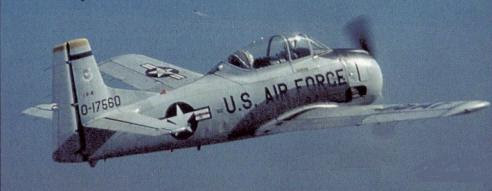
Below, the US Air Force T-28A trainer in the 1950s


Beech T-34 Mentor

The Beech T-34 Mentor is a military trainer still in service in several countries around the world. It was America's flying school for young cadet pilots in the 1950s and 1960s. It was developed in the United States by Beechcraft, which is a branch of the Beech Aircraft Company. It performed its maiden flight in 1948, entering service in 1953, both with the US Air Force and US Navy.

The version Beech T-34A was used by the US Air Force as its first post war primary trainer. Meanwhile the T-34C would become the US Navy's main trainer for many years. The Spanish and Canadian air forces also employed this trainer during the Cold War years. It has also been used by the Uruguayan, Ecuadorian, and Colombian air forces.

Piston Engine and Turboprop variants

The Beech T-34 Mentor had a simple design as it was very reliable, safe, and easy to fly. The T-34A was powered by a 500-HP piston engine, while the T-34C by a 715-HP turboprop engine. The turboprop version (Turbo Mentor) trained the US Navy's pilots until it was replaced by the Raytheon T-6A in 2004. This turboprop variant was also exported world-wide.

Technical Characteristics

The Beech T-34 Mentor is a two-seat, single-engine monoplane, which is fitted with straight low wing. Fuselage is all-metal alloy, with a semi-monocoque structure, which allows it higher speeds, aerobatics and a longer fatigue life. The aircraft is equipped with retractable tricycle-type landing gear. The tail unit is of light alloy cantilever structure, having a fixed incidence tailplane and manually-operated trim tabs on the elevators and rudder.

Specification (T-34C)

Type: trainer aircraft

Length: 8.75 m (28 ft, 8 inch)

Wingspan: 10.16 m (33 ft, 4 inch)

Wing Area: 16.71 square meters (180 sq. ft)

Height: 3.02 m (9 ft, 7 inch)

Power Plant: one 715-HP, Pratt & Whitney PTCA-25 turboprop engine.

Maximum Speed: 414 km/h (257 mph)

Range: 1,205 km (745 miles)

Crew: two

Below, the Beech T-34A in service with the Spanish Air Force in the 1970s


 The US Air Force's T-34 Mentor in flight in the 1950s

Below, three T-34C turboprop Mentors in the 1980s


Polikarpov Po-2

The Polikarpov Po-2 was a military trainer aircraft. It was produced in the Soviet Union from 1928 to 1944. It was developed to replace the U-1, which was the Soviet-built version of the Avro 504. Although production of the Po-2 was stopped in 1944, it was resumed after World War II, with thousands more being produced in Poland. It was also used in the Korean War as a reconnaissance and ground attack aircraft.

The first variant of this biplane had been designated U-2 in 1928. However, from 1944 onward, it was called Po-2 in recognition of Polikarpov's efforts in its development. Although it looked obsolete, like a WW1 aircraft, its simple structure and design made it maneuverable and very reliable. Deliveries of the Po-2 began in 1928, and by the time Germany launched Operation Barbarossa in 1941, 13,000 aircraft had been manufactured. Among them, there was also a series of float-plane versions, which were fitted with the 720-HP Wright Cyclone engine.

Technical Characteristics

The Polikarpov Po-2 was a two-seat, single-engine biplane. It had a staggered wing layout, with the upper and lower wing being joined with inverted N-shaped struts. The lower wing was set up backwards, which allowed the pilot to have a better view of the ground at the moment of landing. It had a large tail rudder of broad chord, which linked to the cockpit controls by a series of cable. The fuselage was made of plywood and canvas. Landing gear was fixed. It was powered by one M-11, 5-cylinder, air-cooled radial engine, which delivered 125 HP.

Specifications

Type: trainer/multi-purpose

Length: 8.17 m

Wingspan: 11.40 m

Wing Area: 33.13 sq. meters

Height: 3.10 m

Maximum Speed: 156 km/h

Range: 400 km

Armament: one backward-firing 7.7mm machine gun mounted over the rear cockpit. 125-kg of bombs.

Below, the Polikarpov Po-2 in flight in 1933.

Below, the Polish version of this Soviet biplane.