Showing posts with label Flying Boats. Show all posts

Supermarine Walrus

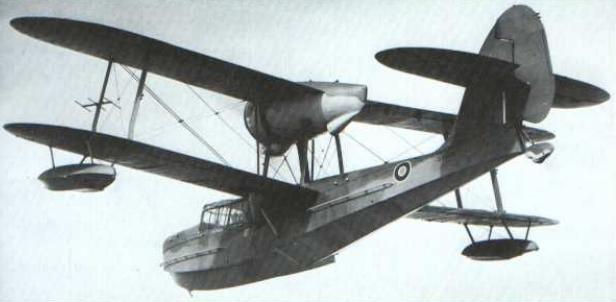
The Supermarine Walrus was a British reconnaissance flying boat, which was in service with the Royal Navy between 1935 and 1950. During World War II, it flew observation sorties and reconnaissance missions over the Atlantic, North Sea, and Mediterranean. The Walrus operated from cruisers, battleships, and aircraft carriers, taking off from launching catapult and flight deck. During the British Norwegian Campaign and East Africa Campaign, it was also used in bombing and strafing missions against enemy positions on sea shores. Once a combat sortie ended, it landed on the sea water alongside the cruiser or battleship, which lifted it off the water with a crane and put it back on its catapult platform. The Australian Royal Navy used it in the Pacific Theater.

Developed from the Seagull, the Supermarine Walrus was conceived by Reginald J. Mitchell. The prototype first flew on June 21, 1933. During the flight trials, it proved to be a reliable aircraft, with remarkable aerobatic qualities. Since the prototype was fitted with landing gear, the Walrus was classified an amphibian aircraft, since it could also land and take off from ground airbase. With the trials complete, the Air Ministry admitted that the results were impressive. It entered service with the Australian Royal Air Force on June 20, 1935, as the Walrus Mk I. The Mk II variant would also be produced. A total of 740 amphibian flying boats had been manufactured by the end of the war. After this armed conflict, it would be used in search and rescue operations, and it was exported to several countries, including Argentina.

Technical Description

The Supermarine Walrus was a single-engine biplane flying boat, with amphibian capability. The hull (fuselage) was of all-metal, stressed skin construction, with an integral lower fin. The landing gear had hydraulic retraction arms set into the hull sides. Both upper and lower wings were made with metal spars, with metal ribs interspaced with wooden ribs; they were fabric-covered, with areas of ply reinforcement. The upper fin and the whole of the horizontal stabilizer and elevator were wooden construction, with stainless steel fittings; the rudder was metal, with fabric covering. Fuel tanks were fitted in the inner ends of upper wing. The aircraft was powered by one Bristol Pegasus VI, 9-cylinder, radial, piston engine, which put out 750 horsepower.

Specifications

Type: amphibian flying boat

Length: 11.46 m (37 feet, 7 inches)

Wing Span: 13.97 m (45 feet, 10 inches)

Wing Area: 57 m2 (610 square feet)

Height: 4.65 m (15 feet, 3 inches)

Power Plant: one 750-HP, Bristol Pegaus VI radial engine

Maximum Speed: 217 km/h (135 mph)

Range: 970 km (600 miles)

Service Ceiling: 5,600 m (18,500 feet)

Crew: four

Armament: two 7.7-mm (.303-cal.) Vickers K machine guns; six 45-kg (100-lb) bombs.

Walrus Mk I in late 1935.

Walrus, with serial # K5780, code WM, on deck of carrier.

Two Walrus Mk.I flying boats flying over the Atlantic before the war broke out.

Supermarine Stranraer

The Supermarine Stranraer, 'Stranny', was a British, maritime, reconnaissance flying boat which was used by the Royal Air Force and the Royal Canadian Air Force during World War II. It operated mostly in the Atlantic and the North Sea. Although it usually was not liked by the crew, the Stranraer was a stable and safe aircraft to fly. When the war broke out in 1939, this flying boat began to carry out combat sorties to intercept enemy shipping between Scotland and Norway. For this types of missions, it was equipped with bombs under one wing and with an extra fuel tank under the other.

Developed from the Supermarine Scapa, the prototype of the Stranraer first flew on July 24, 1934, entering service with the RAF in 1937. A total of 57 Stranraer flying boats were built by Supermarine and Vickers. In British RAF service, the last operational flights flown by this seaplane took place in the Spring of 1941, but it would be withdrawn from service in October 1942. In Canada, it was retired in 1946 as it was used in coastal defense operations. However, this flying boat would continue to be used in civilian aviation by government and private firms for search and rescue operations and mail delivery service. It was also used by regional airlines in Canada as passenger aircraft. No less than fourteen of the Canadian Stranraers joined the Canadian civil register, the most famous operator being the Queen Charlotte Airways on the west coast of British Columbia, providing service to isolated towns in this rugged island chain.

Technical Description

The Supermarine Stranraer was a twin-engine, all-metal biplane flying boat of conventional layout. The fuselage (hull) was of stressed-skin metal construction throughout, with bulkheads at irregular intervals, with access doors at a height to enable some planning-bottom damage control. The forward fuselage was heavily flared into integral chines (intersections) for spray suppression. The cockpit had positions for two pilots, a flight engineer and a navigator station, while there were gun positions in the nose, mid fuselage and tail. The flying boat was powered by two Bristol Pegasus X piston engines, which were slung underneath the upper wing, at the end of the center section, faired by long chord Townend cowlings. The lower wing root was built integral to the fuselage. The upper and lower wing were joined together  by struts and wires. Lower wing was fitted with one float on each side.

Specifications

Type: maritime flying boat

Length: 16.69 m (54 feet, 9 inches)

Wing Span: 25.91 m (85 feet)

Wing Area: 135.4 m2 (1,457 square feet)

Height: 6.63 m (21 feet, 9 inches)

Power Plant: two Bristol Pegasus X, 9-cylinder, air-cooled radial engines, each delivering 920 HP.

Maximum Speed: 266 km/h (165 mph)

Range: 1,600 km (1,000 miles)

Rate of Climb: 6.9 m/s

Service Ceiling: 5,600 m (18,500 feet)

Crew: seven

Above, the Supermarine Stranraer in British service in 1938.

A pre-war Royal Canadian Air Force Stranraer taking off.

The Stranny off the water for maintenance.

Consolidated PBY Catalina

The Consolidated PBY Catalina was an American, long-range flying boat used as a maritime patrol aircraft by the US Navy and US Army Air Forces during World War II. It was the most widely used seaplane during this armed conflict, playing a key role in the Pacific Theater of Operations especially in spotting Japanese warships and radioing a warning to the American fleet. However, it was also employed as a bomber to attack Japanese bases on the coastal areas of the Pacific islands as well as enemy supply ships. The British RAF also employed this hydroplane in the Atlantic and Mediterranean Theater.

The prototype of the Catalina, the XP3Y, flew for the first time on March 28, 1935. It was flown by Consolidated test pilot Bill Wheatley. Although minor problems arose, the first flight tests were satisfactory. After more than a year of evaluation, with correction and improvement, it entered service with the US Navy on October 5, 1936, when the first production flying boat, the PBY-1, was officially accepted by the US Navy authorities at the Consolidated plant at Lindbergh Field, in San Diego, California. More than 3,300 PBY Catalina seaplanes would be built in different versions, with the PBY-3 and PBY-5 being the most massively built and employed.

By the time the United States declared the war on Japan in December 1941, the PBY Catalina was already considered an obsolete aircraft by many in the aircraft industry. However, it would not be phased out, nor would it be replaced, even though more powerful and stronger flying boats would be designed and built in the first couple of years of World War II, such as the Consolidated PB2Y Coronado. The reason was that it was a reliable, low-cost, and easy-to-maintain seaplane. Maritime patrol and convoy escort were its main duties, but in all combat areas, especially in the South Pacific, it also proved to be a capable bomber and an outstanding search and rescue seaplane, saving hundreds of survivors.

Technical Description

The Consolidated PBY Catalina was a two-engine monoplane. It had an all-metal airframe and hull, except the rear portion, which was fabric covered. The flying boat was fitted with semi-cantilever, parasol wing, which was mounted on a pylon above the hull, with a pair of struts on each side to provide additional support. The wing was a conventional aluminum alloy structure, with ailerons being fabric-covered metal structures. Full cantilever horizontal stabilizers were metal-covered. The tailplane was mounted on a large fin and it had fabric-covered elevators, while the vertical fin featured a fabric-covered rudder.

The PBY Catalina was equipped with wing-tip floats and retractable landing gear, which folded up into the side of hull. It was fitted with a nose turret that contained a .30-cal. (7.62-mm) machine guns (two in PBY-5 version) and with two rear blisters, each armed with one .50-cal. (12.7-mm) machine gun. The PBY-1 was powered by two Pratt & Whitney R-1830-64 piston engines, each providing 900 horsepower at take-off.

Specifications (PBY-5A)

Type: long-range, maritime patrol flying boat.

Length: 19.47 m (63 feet, 11 inches)

Wing Span: 32 m (104 feet)

Wing Area: 130 m2 (1,400 square feet)

Height: 6.43 m (21 feet, 1 inch)

Power Plant: two 1,200-HP, Pratt & Whitney R-1830-92 Twin Wasp, 14-cylinder, air-cooled, radial engines.

Maximum Speed: 315 km/h (196 mph)

Range 4,828 km (3,000 miles)

Service Ceiling: 4,800 m (15,800 feet)

Rate of Climb: 5.1 m/s (1,000 feet/minute)

Crew: 10, including the pilot.

Armament: 10 machine guns, plus 1,814-kg (4,000-lb) of bombs.

Below, a US Navy's PBY-4 Catalina flying over the Pacific in 1942. No 15 of VP-13.

A color picture of a PBY-5A version on the dirt ramp of a forward base on one of the Aleutian Islands in December 1943.

Below, a US Army Air Forces Catalina, No. 72 floating on the water in an Aleutian island bay.

The reliable flying boat on a US Navy's airbase. Usually, when operated from land bases, the Catalina's wing-tip floats were retracted for take-off and flight.


Consolidated PB2Y Coronado

The Consolidated PB2Y Coronado was a long-range flying boat employed by the US Navy as a bomber and maritime patrol aircraft during World War II. It was also used in anti-submarine warfare and as a transport seaplane by the British Royal Navy. With heavy defensive armament, long-range capability, and a large weapons load, this American flying boat had the potential to become the US Navy's most important maritime patrol and anti-submarine aircraft during this armed conflict. However, massive production preference was given to the PBY Catalina, of which thousands were produced.

The prototype of the Consolidated PB2Y Coronado, the XPB2Y-1, first flew on December 17, 1937. The first flight tests were satisfactory, winning the contract and beating its competitor, the Sikorsky XPBS-1. However, the first prototype had minor lateral instability problems, which Consolidated´s designers corrected right away by replacing the tail assembly, using a ¨V¨-shaped tailplane, with two fins, and a larger wing; the nose profile was also changed. Including the prototypes, only 217 Coronado flying boats were made.

The main production version was the PB2Y-3, which would be followed by the PB2Y-4 and 5 variants. This flying boat entered service with the US Navy in late 1939. It was used only in the Pacific Theater of Operations. Its first combat sortie as a bomber took place on February 9, 1944, carrying out a bombing mission on the Wake Island. The British mostly used the Coronado for hauling freight across the Atlantic Ocean.

Technical Description

The Consolidated PB2Y Coronado was a four-engine monoplane, with the bottom portion of fuselage designed as a hull to enable it to land and float on water; hence, a hydroplane or flying boat. The aircraft was fitted with cantilever, shoulder wing. The tail assembly horizontal stabilizer had a 17-degree dihedral angle. It featured two vertical stabilizers (fins) mounted at each end of tailplane.

This combat flying boat was fitted with self-sealing fuel tanks and protective armor. The PB2Y-3 version was powered by four Pratt & Whitney R-1830-88 Twin Wasp piston radial engines, with each one of them putting out 1,200 horsepower. The PB2Y-4 variant was equipped with four 1,600-HP, Wright R-2600 Cyclone, 14-cylinder, radial engines. Later versions featured air-to-surface radar and photographic cameras.

Specifications (PB2Y-3)

Type: maritime patrol and bomber flying boat.

Length: 24.16 m (79 feet, 3 inches)

Wing Span: 35 m (115 feet)

Wing Area: 165.36 m2 (1,780 square feet)

Height: 8.38 m (27 feet, 6 inches)

Power Plant: four 1,200-HP, Pratt & Whitney R-1830-88 Twin Wasp radial engines.

Maximum Speed: 359 km/h (223 mph)

Range: 3,814 km (2,365 miles)

Service Ceiling: 6,250 m (20,500 feet)

Crew: 10

Armament: three 12,7-mm (.50-cal.) M2 Browning machine guns, mounted in bow, dorsal and tail turrets; 5,443-kg (11,975-lb) of bombs, or depth changes, or torpedoes.

The Consolidated PB2Y Coronado historical footage (video)

Below, the PB2Y-3 version in flight in 1944, over the Philippines. This version would be converted into the PB2Y-5.

The prototype of the Coronado, the XPB2Y-1 during one of its first flight tests. Notice the single fin and straight tailplane, which would be replaced sooner.


Martin PBM Mariner

The Martin PBM Mariner was a patrol flying boat used by the US Navy and Royal Australian Navy during World War II. Made in seaplane and amphibian versions, it was the most important naval aircraft in its class during this armed conflict. It was a versatile, reliable and easy to fly aircraft. It was widely employed as a replacement for the Consolidated PBY Catalina, which was the only better known flying boat. The Mariner was used in every combat theater, from the Pacific to the Mediterranean as it was also employed as a bomber. Martin built a total of 1,366 PBM flying boats.

The prototype of the Mariner, the XPBM-1 (BuNo 0796), made its first flight on February 18, 1939. It was equipped with two Wright Cyclone R-2600-6 radial engines, each one of them providing 1,600 horsepower. The first flight tests were satisfactorily, with only some tail problems. Flight characteristics were also good. To solve the tail flaw, dihedral (upward angle) was added to the horizontal tail surfaces. The flight test phase would take more than a year as it was accepted by the US Navy into service on October 10, 1940, as the PBM-1 Mariner. It was first assigned to the VP-55 and VP-56 Squadron in Norfolk, Va.

The PBM-3 and PBM-3D were the most widely used versions, with the PBM-3R being a transport Mariner and the PBM-3S an anti-submarine variant. The PBM-5 was a postwar version, which flew sorties in the Korean War (1950-1953). In the bomber role, the Martin PBM Mariner fought everywhere in the Pacific Theater. It was particularly active at Saipan and during the liberation of the Philippines in 1944.

Technical Characteristics

The Martin PBM Mariner was a two-engine monoplane flying boat. It was fitted with cantilever gull-wing, which was mounted high on shoulder of fuselage. The tailplane had a 15-degree dihedral and two vertical fins, one at each end. The amphibian variant was equipped with retractable landing gear. The PBM-3D version was powered by two Wright Cyclone R-2600-22 radial engines, each one delivering 1,900 HP. All-in-all, this flying boat was reliable, sturdy, and tough, being able to take a lot of beating. Pilots and crew had great confidence when they flew sorties with the Mariner as it had been optimized to give them the strongest chance of survival.

Specifications (PBM-3D)

Type: patrol/bomber flying boat.

Length: 24.38 m (80 feet)

Wing Span: 35.97 m (118 feet)

Wing Area: 130.71 m2 (1,407 square feet)

Height: 8.23 m (27 feet)

Power Plant: two 1,900-HP, Wright Cyclone R-2600-22, 14-cylinder, radial engines.

Maximum Speed: 338 km/h (210 mph)

Range: 3,597 km (2,235 miles)

Service Ceiling: 6,095 m (20,000 feet)

Armament: eight 12.7-mm (.50-cal) machine guns set up in nose, dorsal turrets, waist, and tail; 800-kg (1,649-lb) of bombs.

Crew: seven.

Below, the prototype XPBM-1 in a flight test in March 1939. Notice it still had the straight horizontal tailplane. It would soon be replaced a new one with 15-degree dihedral angle.

The PBM-3D variant of the Mariner flying over a naval base in 1943. Notice the search radar on the forward dorsal side of fuselage, right above cockpit.

Below, the Mariner PBM-5A in 1948.


Grumman HU-16 Albatross

The Grumman HU-16 Albatross was an American search and rescue flying boat. It was in service with the US Air Force, the US Coast Guard, and the US Navy from 1949 to 1983. The Hellenic Navy also used this amphibious aircraft. Formerly known as the SA-16, a total of 466 Albatross flying boats were built between 1947 and 1961. It was used in the Korean and Vietnam War, plucking dozens of downed pilots and crew members out of the hostile waters.

The Albatross prototype, the JR2F Pelican, first took to the air on October 1, 1947. It was officially introduced in December 1949 as the SA-16A (HU-16A), when the US Air Force received its first batch of 99 flying boats. This branch of the United States military would acquire the largest number of Albatross, with a total of 305 seaplanes, which included the HU-16B version, with a wider wing span. In March 1952, it entered service with the US Coast Guard as the HU-16E. The HU-16C (formerly designated UF-1) would be used by the US Navy.

The ASW Albatross

In May 1961, the anti-submarine warfare version of the Albatross made its first flight. The development of this variant had begun in 1960 as part of a Military Defense Aid Program (MDAP) project to produce an anti-submarine patrol aircraft suitable for the air forces of friendly nations. Two prototypes were built first for the trial period. It was the most radically different of the Albatross family.

This combat seaplane had a bulbous upswept nose radome, which housed an AN/APS-88 search radar. It was also fitted with a magnetic anomaly detector boom, which was extendable from its tail. This was designated SHU-16B, with a total of 13 being used by the Greek Air Force. It was armed with two homing torpedoes and Mk-54 depth charges.

Below, a United States Coast Guard HU-16E Albatross flying along the eastern coast.


Technical Description

The Grumman HU-16 Albatross was a twin-engine, amphibious monoplane, with shoulder-mounted wings. It was of conventional, all-metal construction, consisting of a deep "V" two-step hull. The wing featured fixed leading edge slots, outboard of the float pylons. The purpose of these slots were to enhance low-speed performance and handling characteristics. It had landing gear for on the ground operations; this retracted up and flush into wells on the hull sides. It was powered by two Wright R-1820-76, air-cooled, radial engines, each one producing 1,425 horsepower.

Specifications (HU-16A)

Type: search and rescue seaplane

Length: 18.49 m (60 ft, 8 in)

Wing Span: 24.38 m (80 ft)

Wing Area: 77.39 m2 (833 sq. ft)

Height: 7.39 m (24 ft, 3 in)

Power Plant: two 1,425-HP, Wright R1820-76A-94 Cyclone, 9-cylinder, air-cooled, piston radial engines.

Maximum Speed: 383 km/h (237 mph)

Range: 4,310 km (2,680 miles)

Service Ceiling: 7,560 m (24,800 ft)

Crew: 4/ or 6

A Grumman HU-16 Albatross of the Japanese Navy in 1957 (video)


Below, a US Navy UF-1 (HU-16C), with dry floaters.

A HU-16A of the US Air Force flying over the coast of California.


Dornier Do 24

The Dornier Do 24 was a long-range, rescue and maritime patrol flying boat. It was used by the Luftwaffe in the North Sea, Mediterranean, and Baltic Sea coastal regions, during World War II. A total of 279 Do 24s were produced in different variants. The Dutch, French, and Swiss also made this flying boat under license before Germany invaded France and the Low Countries in May 1940.

The Dornier Do 24 had been designed to meet the Royal Dutch Navy's requirement for a maritime patrol aircraft, which would be used in the Dutch East Indies, in the Far East. The prototype V3 made its maiden flight on July 3, 1937. After several flight tests, it entered service with the Dutch Navy in November 1937, as the Do 24K-1 version. A total of twelve were delivered to Holland before the German invasion of France and the Low Countries. Although the prototype was fitted with three Junkers Jumo 205 diesel engines, the final production variant for the Dutch was powered by Wright R-1820 Cyclone engines. Nine Do 24Ks would be sent to the East Indies to fight against the Japanese.

Below, the V1 prototype, powered by three Junkers Jumo 205 diesel engines, in 1938.


Although the Luftwaffe showed little interest in this flying boat at the beginning, two prototypes of the Dornier Do 24, which had been stored in a hangar, were hastily upgraded and fitted with defensive armament (one 20mm cannon and one 7.92mm machine gun) in March 1940. These two maritime aircraft were delivered to the Luftwaffe's Kampfgeschwader 108. for special operations during the German invasion of Denmark and Norway. After the fall of Holland in German hands in late May 1940, the Dutch De Schelde and Fokker companies would keep producing the flying boat for the German Luftwaffe. Thus, eleven would be delivered as Do 24N-1 in the fall of 1941. By the end of 1944, a total of 170 flying boats had been delivered to Germany from the Dutch factory assembly lines.

Technical Description

The Dornier Do 24 was a three-engine monoplane flying boat. It featured straight, braced parasol wing. It had a two-step, all-metal hull, with the rear portion curving slightly upwards and ending up in a twin-fin tail. Wide sponsons stuck out from each side, giving the hydroplane stability when it was on water. The Do 24T-1 version was powered by three BMW Bramo 323R-2 Fafnir, 9-cylinder, radial engines, each rated at 1,000 horsepower. These engines were mounted side by side on the wing above the cockpit/cabin, which was big enough for a crew of six.

Specifications (Do 24T-1)

Type: rescue and maritime patrol hydroplane.

Length: 22 m (72 feet, 4 inches)

Wing Span: 27 m (88 feet, 6 inches)

Wing Area: 108 m2 (1,162.5 sq. feet)

Height: 5.75 m (18 feet, 10 inches)

Power Plant: three BMW Bramo 323R-2 radial engines.

Maximum Speed: 331 km/h (206 mph)

Range: 4,700 km (2,920 miles)

Service Ceiling: 7,500 m (24,605 feet)

Crew: 6 men

Below, the V3 prototype, which would become the Do 24K-1, the Dutch version, in flight in 1939.


The Do 24T-1, German variant, which excelled in the rescue role.


Dornier Do 18

The Dornier Do 18 was a German maritime patrol and air/sea rescue flying boat. It was used by the Luftwaffe during World War II, flying sorties off the coast of Norway and Denmark on the North Sea, and along the coastal areas of the Baltic and Mediterranean Sea. The Do 18a prototype made its maiden flight on March 15, 1935, serving with the civil airliner Lufthansa along with the Do 18c prototype, under the civilian designation Do 18E.

The first version to be used by the Luftwaffe, as a maritime patrol flying boat, was the Dornier Do 18D. Deliveries to the Luftwaffe began in 1936, from Dornier's own Friedrichshafen factory. This variant was fitted with twin water rudders and controllable radiator flaps and it was powered by two Junkers Jumo 205C diesel engines, each delivering 600 horsepower. These machines were mounted in tandem, sharing the same shaft. By 1944, all four military variants (Do 18D, 18G, 18H, 18N( had been replaced by the more powerful and reliable Blohm und Voss BV 138 flying boat. A total of 170 flying boats were made.

Below, the Do 18D variant in flight over the North Sea.


Technical Description

The Dornier Do 18 was a four-seat, two-engine monoplane, with a fuselage adapted to take off and land from water. It was fitted with braced, straight high-wing. The engines were set up in tandem just above the wing, at the center of aircraft. Its two-step hull consisted of seven compartments, all of which were water-tight. Compartmentalized sponsons (known as Stümmel) provided lateral stability on the water, also contributing to lift in the air when taking off.

The Dornier Do 18 featured an enclosed cockpit, which housed pilot and co-pilot side by side, and radio operator and navigator immediately aft. A compartment over the rear step provided space of a defensive machine gun, with another open gun position in the nose.

Specifications (Do 18G version)

Type: maritime patrol, reconnaissance, and rescue flying boat.

Length: 19.38 m (63 feet, 7 inches)

Wing Span: 23.70 m (77 feet, 9 inches)

Wing Area: 98 m2 (1,055 sq. feet)

Height: 5.32 m (17 feet, 5 inches)

Power Plant: two Junkers Jumo 205D, 6-cylinder, piston engines, each rated at 880 HP.

Maximum Speed: 267 km/h (166 mph)

Range: 3,500 km (2,175 miles)

Armament: one 13mm MG-131 machine gun, and one 20mm MG-151 cannon. Racks for two 50-kg bombs.

Below, the Dornier Do 18 flying a sortie over the Mediterranean Sea in 1942.

The German flying boat at a Luftwaffe military base on the coast of Norway.

Blohm und Voss BV 138

The Blohm und Voss BV 138 was a German flying boat and maritime patroller, which was used by the Luftwaffe during World War II. The first prototype, the Ha 138 V1, took off on its maiden flight on July 15, 1937. After improvement made and the hull enlarged, it was finally approved for mass production after three years of flight tests. It entered service in October 1940 as the BV 138A-1, on time to take part in the Norwegian Campaign. Because of its distinctive shape, it was called the 'Die fliegende Holzschuh' (the flying clog).

The BV 138A-1 version was followed by the BV 138B-1, which first flew in December 1940. The second one was a much superior machine than its predecessor. Armament consisted of a forward-firing 20-mm MG-151 cannon, set up in a turret in bow portion of aircraft, and a 7.92-mm MG-15 machine gun, which was mounted in an open position behind the central engine nacelle. Later, a factory conversion would increase the weapon load to six bombs or depth charges. The BV 138C-1 variant had a strengthened airframe, a four-bladed propeller on the central engine, and an additional 13-mm machine gun in the starboard side fired by the radio operator.

From the Norwegian bases, the Blohm und Voss BV 138 flew sorties over the North Atlantic and Arctic oceans, tracking and attacking convoys bound for Russia. During one of its many missions, it shot down a Catalina and a Blenheim. In northern waters, this German aircraft got refueled from U-boats. Meanwhile, the BV 138C-1 operated in the Black Sea region, taking off from Constanza, Romania. It was also used in the Mediterranean theater in 1943.

Technical Descriptions

The Blohm und Voss BV 138 was a three-engine monoplane flying boat. It was fitted with a cantilever high wing, which was mounted on a pylon above the hull. The wing had split flaps between the ailerons and the fuselage. The aircraft was a three-piece metal construction with sheet plates. The center section, which was made of steel, housed the fuel tank. The hull was a short, single step, all-metal boat.

Specifications (138C-1)

Type: reconnaissance and maritime flying boat.

Length: 19.90 m (65 ft, 3 in)

Wing Span: 27 m (88 ft, 7 in)

Wing Area: 112 m2 (1,206 sq. ft)

Height: 5.9 m (19 ft, 4 in)

Power Plant: three Junkers Jumo 105D inline, piston engines, each delivering 880 horspower.

Maximum Speed: 285 km/h (177 mph)

Range: 5,000 km (3,107 miles)

Ceiling: 5,000 m (16,405 ft)

Crew: 6 men

Below, front view of a BV 138A-1 version at a Luftwaffe base on the Norwegian coast.

The BV 138C-1 flying over the Black Sea in the Summer of 1943. Notice the 20mm gun in the bow section.

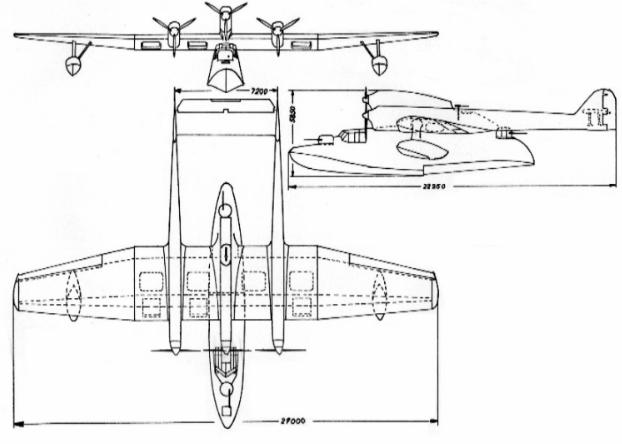
Below, the drawing of the Blohm und Voss BV 138 prototype.

The German flying boat being refueled by a U-boat in the middle of the North Sea.


Supermarine Sea Otter

The Supermarine Sea Otter was a carrier-based, rescue amphibian aircraft used by the Royal Air Force during World War II. Developed to replace the Walrus I, it flew for the first time on August 20, 1938, entering service with the RAF coastal command squadrons in late July 1943. About 290 Sea Otters were built between 1943 and 1946.

The Supermarine Sea Otter flew with the air-sea rescue service during the Burma campaign between 1944 and 1945, on board the escort carrier HMS Khedive (D-62), with the No 1700 Squadron. It was also assigned to No 1701 Squadron of the East Indies Fleet based in Ceylon in February 1945.

Technical Characteristics

The Supermarine Sea Otter was a four-seat, single-engine biplane. The aircraft wing lower deck was mounted high on the fuselage, while the piston engine was set up high on the upper deck. Both decks were jointed by sturdy parallel struts. The fuselage was all-metal. The biplane was equipped with two floats, one fitted at the end of each wing.

Specifications

Type: communications and rescue amphibian aircraft.

Length: 12 m (39ft, 5in).

Wingspan: 14.02 m (46ft).

Wing Area: 56.67 square meters (610 sq.ft).

Power Plant: one 855-HP, Bristol Mercury XXX, radial piston engine.

Maximum Speed: 241 km/h (150 mph).

Range: 1,167 km (725 miles).

Armament: three Vickers 7.7mm Vickers machine guns.

Below, the Supermarine Sea Otter II version.


Kawanishi H6K

The Kawanishi H6K 'Mavis' was a long-range, reconnaissance aircraft employed by the Imperial Japanese Navy during the Sino-Japanese War and World War II. Designed and developed by the Kawanishi Aircraft Company, Ltd, it performed its maiden flight on July 14, 1936 and entered service on January 27, 1937. Although it was retired at the end of the war, it had been largely replaced by the more advanced Kawanishi H8K Emily.

The H6K3 and H6K4 were the main versions of this flying boat. By 1942, which was the last year of production, 215 Kawanishi H6K airplanes had been made. It was officially known as the Navy Type 97. It carried out reconnaissance sorties near the coasts of Hawaii a couple of months before the Japanese attack on Pearl Harbor. It was also used as a bomber in anti-submarine warfare, carrying torpedoes. When used as a transport, it had accommodation for 20 passengers in three cabins.

Technical Characteristics

The Kawanishi H6K was a four-engine hydroplane (flying boat). Strictly technically, it was a braced parasol monoplane, which means it had straight wing mounted above fuselage and propped up by struts. Fuselage was all-metal, but moving parts, such as flaps, ailerons, and rudder were fabric-covered. Being a flying boat, it lacked traditional landing gear but it was fitted with wing tip floats to balance it at the moment of landing on water.

Specifications

Type: Reconnaissance flying boat

Length: 25.63 m (84 ft, 1 in)

Wingspan: 40 m (131 ft, 3 in)

Wing Area: 170 square meters (1,800 sq. ft)

Height: 6.27 m (20 ft, 7 in)

Power Plant: four Mitsubishi Kinsei 43, Model 46, 14-cylinder, air-cooled piston engines. Each one put out 1,060 HP at 13,800 ft.

Maximum Speed: 360 km/h (237 mph)

Range: 4,800 km (2,983 miles)

Ferry Range: 6,100 km

Crew: 8

Armament: four 7.7mm machines gun; one 20-mm cannon; 1,600-kg bombload (two 800-kg bombs).

Below, the blue-print plans of the Kawanishi H6K flying boat.


Below, old photograph of the H6K3 variant taken around 1937.


Beriev Be-6

The Beriev Be-6 was one of several Soviet flying boats. The development of this aircraft started in 1944, with the first test flight taking place in 1946. It was finally introduced in 1952. This versatile aircraft of the Cold War years played several important roles for the Soviet Navy; coastal patrol, reconnaissance, search and rescue, transport, mine laying, but it was also a long-range torpedo-bomber. In 1957, it was fitted with updated sonar and radar for searching NATO's submarines marauding near the Russian sea coasts. It would be phased out of duty in 1968.

The Beriev Be-6 was a two-engine heavy monoplane. It featured gull wings, which were mounted high on the fuselage. The fuselage was all-metal, with its belly having the shape of a keel for operating in sea waters; thus, when it was above water, it resembled the keel of small ship. The aircraft had a two-fin tail, with a V-shaped horizontal stabilizer. The 'landing' gear consisted of the keel-shaped fuselage bottom and two small floats, each one set on each wing. The power plant was composed of two Shvetso ASH-73, 18-cylinder radial engines, which delivered 2,400 HP. The main production version was the Beriev Be-6M. The anti-submarine variant was the Be-6PL, fitted with a hydro-acoustic detection system.

Specifications

Type: Flying Boat (Reconnaissance/Torpedo-Bomber)

Length: 23 m

Wingspan: 33 m

Height: 7.45 m

Payload: 4,100 kg

Maximum Speed: 377 km/h

Range: 4,800 km

Armament: two heavy torpedoes and two rear 20mm cannons.

Below, the Beriev Be-6M on Baltic sea water.